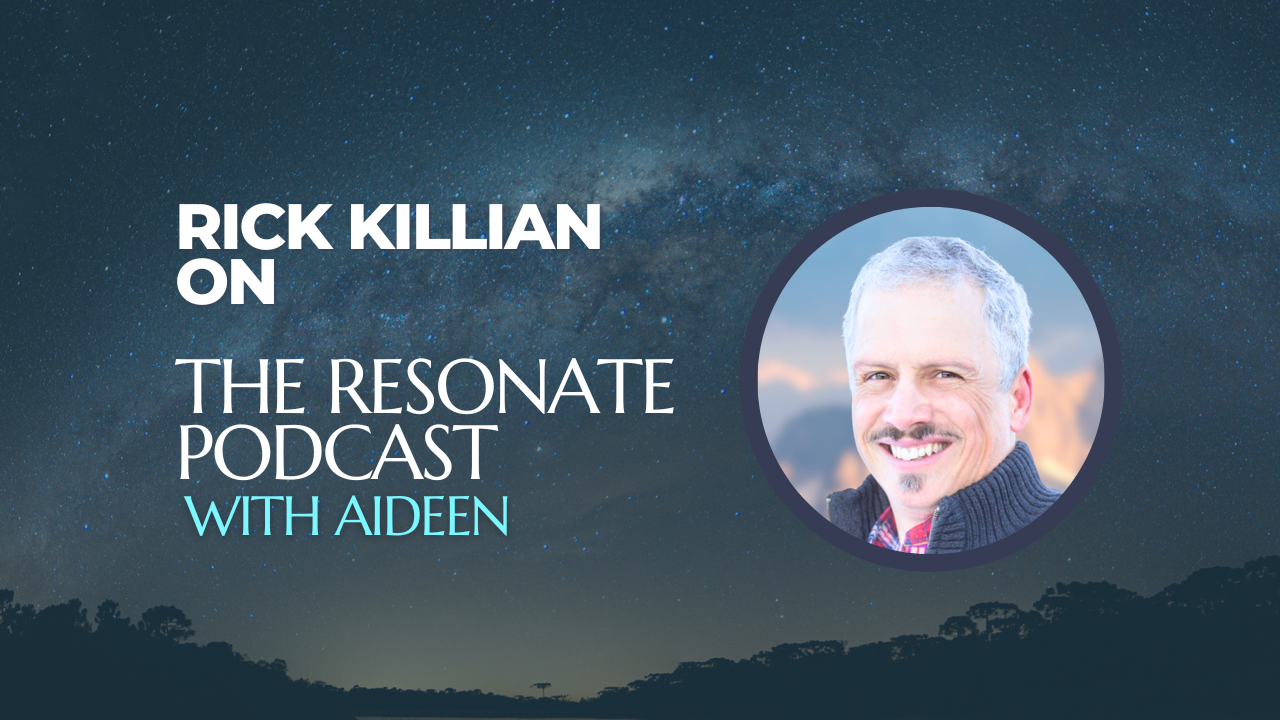
The Transformational Power of Writing a Book with Rick Killian
What if the real reward of writing a book isn’t the bestseller badge but the person you become along the way?
In this episode, Aideen sits down with New York Times bestselling ghostwriter and publishing coach Rick Killian to explore how curiosity and storytelling transform scattered ideas into a clear and compelling message.
Rick shares how the writing process often reshapes the author as much as the manuscript. Together, they explore the differences between ghostwriting, developmental editing, and coaching, and why authentic voice and lived experience create the kind of connection that turns readers into loyal followers and clients. If you’ve ever felt the pull to write a book but didn’t know where to start, this conversation offers both practical guidance and powerful encouragement to begin.
Connect with Rick
Website: www.killiancreative.com
LinkedIn: @RickKillian
Key Takeaways
• First drafts are a tool for discovery, not perfection
• Storytelling helps translate abstract ideas into lessons that truly resonate
• Books can establish credibility and create meaningful connections with future clients
• Turning common client questions into chapters can be a powerful book structure
• The most important step in writing a book is simply beginning
If you feel the pull to write a book, consider this your invitation to begin. Start exploring your ideas, follow your curiosity, and reach out to Rick or Aideen if you’d like guidance along the way. Your story may be the message someone else has been waiting to hear.
💌 Get a Free Gift!
Leave a review of the podcast and get Aideen’s Discover Your True Value eBook plus a 21-Day Self-Love Journal as a full-colour downloadable PDF. Just email a screenshot of your review to: info@confidenceinsinging.com
Transcript
Meet Rick Killian & His Path
Aideen Ni Riada 0:03
Welcome to the Resonate Podcast with Aideen. I'm Aideen Ni Riada, and I'd love to introduce you to my guest, Rick Killian, who's going to be talking to us about finding your voice through the written word. Rick is a three-time New York Times bestselling ghost writer and publishing coach. He and his wife Melissa work together and they love guiding thought leaders on the adventure of turning their ideas into books that make a real difference in the world. Rick, I'd love to hear how you got started as a ghostwriter. I believe you were working in the editing world and something happened that propelled you into it.
Rick Killian 0:43
Yeah, it's kind of funny how it always happens. Um I taught school for several years, high school and middle school, and always loved writing. So I got into editing with a small publishing house. And of course, we had success. Uh, we had a successful book. And so what happened was our parent company sold us. So I ended up working with all of the editors from our old house to transition them into the new house. And what happens is your editors they come back to you with something not to edit, they come back with the idea that, well, now I have an idea for a title. Would you just write it for me? And so that transition happens just about that fast.
Ghostwriting Vs Editing
Aideen Ni Riada 1:22
Wow. Did you enjoy ghostwriting more than editing? What's the difference from your perspective?
Rick Killian 1:29
There's a lot of similarities when you talk about developmental editing, someone who comes alongside somebody at the beginning of their process, which is a lot of what I got to do as a publishing uh person, as a publishing editor. So the transition to that is just kind of you have to get into their head a little bit more and kind of become them, find their voice and take that on and start writing from their perspective. And so there's a little bit more of an involvement with, I mean, with with um developmental editing, you can kind of be a little bit distant and a little bit more like you need to do this, you need to do that. Um, so it's a little bit smoother to do the ghostwriting because you can just do it.
Aideen Ni Riada 2:13
You have more control over it.
Rick Killian 2:16
Yeah, you do, and you also have more responsibility to them and their message to make sure that you're really getting it right. So it's a lot of fun to do that, sit in with somebody and get into their head and do it.
Aideen Ni Riada 2:27
I was interested in having you come on the show because of this um connection to finding your voice and you know, having a message. Because my ethos is that whether you're singing or you're speaking or you have your own business, that each of us brings a unique perspective, unique experience together that when we share it, it has a unique impact. And I know that the written word, and I I love writing myself, and I have one my my one little self-help book that I wrote called Discover Your True Value, because finding your value was, you know, understanding that each of us has value, each of us have a message that has value is so important to me. So when you were um speaking at my last voice summit, I really felt that it would be useful for people to hear from you whether they know that they have a message, whether they have a business and they're trying to promote themselves, or whether they just have a story, um, a life story that perhaps could be useful to others. And so what I would be wondering is when can someone you know believe in the value of writing a book? Like, do you have to have some major big life event like oh a near-death experience? Or what kind of um you know ingredients do you need for the recipe for a good book?
Rick Killian 4:04
I think the biggest one is curiosity. Um, you know, along with all those unique things you say, everybody has a unique brilliance. They see the world in a way that nobody else does. Um and I I think there's a kind of a belief that um people have that if the universe sort of gives you a book, that it's gonna be a bestseller. But I find that writing's nothing about I mean, that's all secondary to what really writing can do for a person and and do with it. You get to learn so much. There's something that happens when you put something down on paper. You know, I think artists have the same way, people who draw, people who take photography, do photography probably a little bit less, but there's something that when you get an idea out of your brain, you begin to find what's underneath it. So there's a process of like discovering your own unique genius, and then being able to put it down on paper, and then being able to go out and investigate what have other people in the world said in the past about this, what have the ancient philosophers said about this? What did this best-selling author say about that? And you start to find yourself in perspective with the world around you, and then you start to find out what you really do have to offer other people. So, book writing and writing, just in general, I mean, I think people know this who just journal, realize this to a certain point. But then to write a book is to kind of spend a long time thinking about a really big idea that you're really curious about, that you really care about, and then putting it into a linear format that other people can understand. So a lot of people times I tell people that until they get their first draft done, they don't even really understand what their idea is. That's the first time that they've laid out all the pieces on the board, and they can start to see what the puzzle really looks like to be able to put it together. And that's a powerful process, and that's kind of why I switched from just, you know, I started as a teacher, got into editing, got into ghostwriting because people didn't want to take the time to write the book themselves anymore or have me walk it through it, and then kind of got back into coaching and publishing coaching and writing coaching because I realized when I write a book for somebody, it takes away from them what they could have learned on their own, that experience of writing. So we got back into the coaching, not because it makes us more money, but because, and it doesn't, but because it helps people so much to see their story. They're a different person at the end of the writing process than they are at the beginning.
Aideen Ni Riada 6:43
I like that idea that there's a value to the journey, not just to the end goal.
Rick Killian 6:49
There definitely is. In fact, I tell a lot of people that even if they never sell a book, having written it is just so incredibly valuable. And then everything after that's just a bonus. Beautiful.
Drafts As Discovery
Aideen Ni Riada 7:01
I know that you know, having written a little book, and you know, it's um it's not something that I've marketed hugely, but the people who have a copy that say that it feels like me, that it that it makes them you feel happy, that it gives them joy, and that really makes a difference. It's I mean, I think we all have um so much, there's so much connection between us, and we forget this. I think most people forget that they have people in their life that actually like them, right? If you don't talk to the people who like you for a few weeks, you don't know they like you anymore. And you know, during COVID, everybody was in their separate camps, we weren't really connecting. But you know, my my book is is a nice way for me to have something I can connect with people. They can have a little piece of me, and it's a way for me to pass that on and even give them to people as a bonus, as part of you know, working with me as a coach or anything like that. Um, what's the most interesting? Like, what are you most curious about right now in terms of storytelling?
Rick Killian 8:11
You know, story is very, very, very powerful. And so what I'm realizing more and more as I get into this is that most people's wisdom comes from the life experience that they've had. That may seem like an obvious thing, maybe, but they don't know how to tell the story of what they know through the story of what's happened to them.
Aideen Ni Riada 8:37
The story of what you know and the story of what happened to them. So that I mean you've just divided, I just think of it as one story, right? I'm sure most people do. Right. But that is a curious way to to separate things, right?
Rick Killian 8:54
Yeah, well, because you don't realize at the time that that's what you learned. Does that make any sense?
Aideen Ni Riada 8:59
Yeah. You live through something.
Rick Killian 9:01
As you look back, yeah, as you look back writing it, then you can say, oh yeah, that's when I learned that. And it's funny, I've done you know, close to 80 different books with different people through coaching, or almost all of those, probably 80, just ghostwriting. And everybody has sort of things that they want to teach the world when they want to write a book. I mean, that's naturally why you have your five reasons for this or your 12 steps to that, or your 21, you know, leadership things or whatever. But all of those you learned through your life and you saw the value of them through something you experienced. And so being able to take authors back to connect them to when they learned it, and then use that story as a parable to help them teach what they know, it's just so much more powerful than just kind of unpacking, you know, this is a principle, and here it is, and let me explain it, and there you go. And I hope that helps you. But when you help them sit sit in it through a story, and then you get a chance to unpack it, and then maybe you give like some metaphors or other things to understand it, your book becomes a lesson in its own. And it's funny how much you can put down on paper and people still want to come, you know, work with you. I mean, it's a it's a no like and trust thing. You probably found that with your book, you know. And and I think that's the that's the hardest part for most of us that do entrepreneurship, that have some teaching that we want to do, is you feel so salesy when you talk to people up front about this is what I can offer you. You know. Um, but when they read your book first, they get to know you, like you, and trust you before they've even met you. And by the time you get a chance to meet with them, you don't have to sell them anymore. Plus, they already kind of have a basic understanding, so you can already start to take them deeper. So it's been really interesting, you know, to work with clients on that, and especially people who have some kind of a coaching or some kind of uh of uh knowledge or experiential, you know, sitting meditation, different things.
Aideen Ni Riada 11:15
Have you taken on some of those? Obviously, in 80, 80 books. How who do you who did you learn the most from? Like which book did you learn the most from?
Rick Killian 11:26
Oh, I don't know. I'd have to really think about that. I have to go back. I'd probably have to look at the list because I don't always remember what I've written. But it was really funny when our, you know, when we first started out in business, I felt like all I was doing was financial books. And then when we our kids were hitting their tweens, you know, all of a sudden we're doing parenting books. So, you know, I feel like God had it, knew what I needed to learn when I needed to learn it. And that's interesting. Yeah, it's been a fun journey that way. That we uh I don't know that I've always applied everything as much as I should, but that's kind of the way we get to it.
Aideen Ni Riada 12:05
Oh, that's good though. So because like obviously the author is the author. You don't get named usually if you're a ghostwriter, right? Nobody knows that you've done this, that you've handheld and you know, done a lot of the the the thinking and the and the writing for someone based on, I guess, the conversations you've had with them or other work that they've worked on.
Story First, Lessons Second
Rick Killian 12:32
Well, and even if you get a with on a title, yeah, they don't they still don't think about you as the person who wrote the book. No.
Aideen Ni Riada 12:39
Because the intellectual property and the kind of the ideas that are coming through are primarily the person who's got their name as the author, right? That's right.
Rick Killian 12:52
And that's the value of the book. It's kind of funny because I sometimes speaking, I get tripped up because I'm better on paper. And I think the same thing happens to speakers when they start to see what they've written. It can be actually distracting to them. So you've got somebody who's got great ideas, and that's what the book is going to be about. But they maybe don't have that knowledge or the background. I mean, they haven't, you know, you see in my library, if you see my be on a podcast, there's all these books behind me. You know, they haven't read all the different books that are on that topic. So when you work with a ghostwriter who's worked in that industry before, they've written in there, they've read widely in that, they know things that they can bring in. You know, ghostwriters are always kind of nerds for history, so they can bring in a lot of different perspectives. So, you know, there's your personal story, but then history repeats itself. And there's ways to take other examples from other things and other books out there that can also illustrate your book. And so that's what a ghostwriter brings to it. And it it's really the job to be totally a ghost, totally invisible, right? And come in and put them into your brain and um and then express it to them, but maybe just with a little bit of a literary improvement.
Aideen Ni Riada 14:13
Do you ever feel like you become a therapist to those writers of yours?
Rick Killian 14:20
When I when I taught eighth grade, particularly, I could just, it was so obvious what the kids were working out as they wrote, what things they were exploring and what they were doing. Um, and I think everyone that works with a ghostwriter comes out with a better understanding of what they know. Because that articulation, in you know, because books start with page one and they go to page whatever, 150, 200, 400, whatever. And that's a linear presentation of your of your of your unique knowledge. And for that to communicate to an author, that needs to be or an audience, that needs to be done in a very particular way. Um and succeeding in doing that just helps you understand what you know so much better.
Aideen Ni Riada 15:04
What's the what's the main pitfall for someone that wants to find that, you know, it's like a I always think of sometimes it's like having a conversation with someone who's reading. You know what I mean? That you have to anticipate what it is they're going to be thinking of next. But what are the main pitfalls to put making it linear for for some of these thought leaders that you work with?
Rick Killian 15:29
I think the main pitfall is that it doesn't come linearly. You know, you don't start with word one and end on word 700.
Aideen Ni Riada 15:38
You mean in person's in a person's brain? Yeah, it's not linear.
Credibility, Trust & Books In Business
Rick Killian 15:42
Even the book doesn't come linear, you know. As you write, I mean, I I think the hardest thing for people when they sit down and write is that confidence that what they've got to say is alright. Um, that it has value. And the problem is with writing is that you've got to write the idea that's in your brain now before you get to the idea that's underneath it, or that gets to the deeper idea, okay? Or that gets to the deeper idea. So you don't do one draft, you know, you talk about drafts, right? Well, it's a little bit like designing your house. You know, I think maybe that might be a better way to do it. You know, the architect will come in with ideas for what it could be laid out, and it's like, oh, can you add this, or can you move this wall, or you can do this other thing. So there's thousands of iterations of being able to say the right thing. There's a great quote by uh Kurt Vonnegut that says, and I'm gonna kind of mess it up, he says, writers aren't smart because you know they're some intellectual genius. Writers are smart because they're patients. It's like blowing up a dirigible with a hand pump. They just work at it over and over again until they get the right sentence. So, you know, how many times you you know, everybody only sees the last sentence and the way it came out at the end. But there were so many iterations of that, and I call it sentence gymnastics where you move things around and set it differently to try to find the best expression or the best story or the best whatever. And you have to let yourself go through those iterations and those changes. And that can be a real confidence suck, you know, because you feel like I don't understand this as well as I thought I did. But that ability to get it on paper and stand up and walk away and go for a walk and then be driving in your car or be in your shower, that's the classic, right? When that idea comes to you, crystalline, as exactly how it needs to show up on the page, it's the patience to have that that people don't realize that they need. Because we don't we don't teach writing as iteration. We really should. We really should spend a lot more time with that.
Aideen Ni Riada 17:57
What do you mean by the word iteration?
Rick Killian 18:00
Well, iteration is like changing things a little bit, a little bit all the time, right? So you talk about that when anytime you're inventing something, especially like with I mean, software people talk about alike, but products are like that too. So think of divine designing, you know, what was it like to design the first iPhone, right? And to take the examples that they had before, like when I was in high school, cell phones look like bricks, right?
Aideen Ni Riada 18:27
That was one iteration of a cell phone.
Rick Killian 18:30
Yeah, that was the first iteration that we saw of a cell phone, and look at what it is today. Plus the fact that you know, we can do with a with a cell phone now what a what a room full of computers couldn't do when they were gonna put a man on the moon, you know? It's crazy. And and to think how many millions of dollars of equipment you would need in 1990 to replace what a what an iPhone does now, you know. So there's all of those are changes and all of those are improvements. And that's kind of the process with writing. You get to try it again and again and again until you get it right. And that's hard to do in a vacuum, right? Because there's so much self-confidence that needs to do it, which is almost why it's easier for me to write as a ghostwriter than it is to write my own stuff. Because um, you know, I get it find somebody else's voice and I know what their genius is. I mean, I'm it's always surprising too to talk with an author and tell them what their genius is. Because they don't necessarily know that particular deal.
Nonlinear Thinking And Iteration
Aideen Ni Riada 19:36
Yeah, so you're looking at it from a completely you know fresh eyes. You are you have in your mind also an idea of what connects with people, like what connects with an audience. And to kind of see someone, to see everything they've currently got and to have them talk to you about what they've got, you can see into them something that they may not see as an obvious, say, unique selling point. Because I mean that's what every you know author really needs or every book needs, is they need it to have something that makes it a little different from everybody else's version of it, right?
Rick Killian 20:14
Yeah, and they don't realize what it is through their process. Um, probably the best example of that is that we had an author come to us that's just coming back, actually, to write her second book now. Um but she she coaches people. Her book's called Finding Your Next. And it she spells next NXT because the idea is it's so urgent you don't even have time to write it out completely. Um, and it's about finding the next big phase of your life, the next big change, the next big development. And she's like, Well, I want to coach on this, and I know I have to have a book, right? Because everybody, anybody's a thought leader if you have to have a book to be a thought leader, right? She goes, but I don't have like five steps of this or 12 steps of that. I don't really have a method. I just sit down and talk with people. And I said, Okay, well, let's meet, let's get together, we'll come out and pretend like you're we're your clients, and we'll talk together and figure it out. And we as we talked, and she told us about what she did, and she gave us stories about different clients she's worked with and different things, we started hearing the same questions over and over again. So we discovered that she really had this series of questions that she answered throughout her process of coaching somebody, not always in the same order, you know, always unique to their particular take, but the same questions. So I said, Well, what if you wrote all your questions down and then answered them? What if that was like your first draft of your book? So she took about a year to do that. And she had really interesting questions. She had probably 16, 20 questions in the end that did it out. And so I said, Okay, now let's look at your life and see do you have a time in your life where you kind of worked through each of these questions yourself and learned them? Well, she Sold her business. She'd bought a piece of land in southern Colorado that has a beautiful view, a farm, a ranch, and then they had to build a house on it. And so it turns out everything that she wanted to teach other people, she'd learned in this process of going from a city girl in Boulder, Colorado, owning a you know a big company, selling the company, and then deciding not wanting to retire and just go into obscurity to when she started her coaching business, which included moving to southern Colorado, buying a ranch, building a house, building a ranch, the whole process. And she could go through each of the questions that she did and illustrate it with something that she'd learned. You know, from like having the first chickens in the place to the first sheep to whether or not she was gonna name her goats, you know, all these different steps that they had to go through, all the little iterations of developing her business. And we put all those together, we created three different threads of the story, the question, and all the things she taught clients to do that. And then in the whole process she's doing that, it's changing the way that she's coaching. So whatever chapter she's on this week, she's teaching in her book, in her clients, when she's meeting with clients for the weekends for her her immersions that she does. Wow. And uh it's been a great, it's been a great tool for her. She did a workbook for it, she's done an audio book, and now uh I think it's maybe four or five years later, she wants to go back and and write book two.
Aideen Ni Riada 23:46
That's an amazing story. I I mean I love the idea that not only did she discover how she works, um, she also discovered the history, the the backstory, and it led her to also then develop what she's currently doing. And there's a huge amount of value in any aspect of that for anybody. But what the thing that I was curious about next was um I know I I was curious when you were speaking because you know you work with your wife, and I was curious whether um you and your wife have a different like um take on it that you that she sees things or you see things that help you to speed this process up or to bring um an extra layer to the process for your clients.
Rick Killian 24:43
Well, what's fun is when you hire us, we both show up. And we always we used to joke that we were like Chip and Joanna Gaines. I guess now they're I hope everybody still knows who they are. It feels like yeah, the fixer upper. So they the fixer upper guys. Yeah. And so he was the guy that fixed the walls and put in and made sure that the roof stood and added the new room and moved and did the kitchen and did all the construction and set up all the framework. She was the one that came in and put the pillows on the couch. I guess that's probably a really, really simplified way of doing it, but made the house look good from the inside. Yeah. And so I'm more of a structural guy. I'm much more of like, how do you set your book up? And she's a poet at heart. So the phraseology and the different things to be able to say different words, that comes across. And then we don't tend to work on the same books at the same time. We've done that maybe once. Um but when we come in and meet with an author, it gives us both perspectives to be able to go. And I can hear her in her when she's talking about this needs to be done to be thinking in this one to approach this particular audience. I can log that. And then there's some authors that just naturally fit more with that poetic need that they've got a little bit more of a framework already, but they need to say it in an elegant way that's really going to resonate with people, and people are going to remember it. I mean, we all, you know, we all know of maybe we don't always remember them, but we all know of those those one quotes, you know, that kind of resonate and stuck with us that really were meaningful. And helping people find that for their work is just that's really a lot of fun.
Finding The Author’s Unique Angle
Aideen Ni Riada 26:34
It is so important that the essence of who you are can come through the words. So I know we're gonna have to wrap things up a little bit, but I was talking with um with someone who's writing a book right now, and she was like, Oh yes, I put my stuff into AI to proofread it, and it ruined it, right? Because I think what was what was she was losing was that essence of her, you know, her her tone, you know, the order she puts in the words. Sometimes, you know, there's there's a fine line there, right? Because I mean, I'm sure some people will worry about this, even working with a ghostwriter. How will they find my voice? How will they make it sound like me?
Rick Killian 27:16
Well, and communicate that soul that is inside of you, that's learned all this, that has always been with you, that kind of connects to the spiritual world at the same time as you're trying to do things, you know, in the physical world. Um I mean, that's kind of what AI will never have. And I feel I I know we we're rushing to have it. I mean, I can't you can't even open Microsoft Word anymore without it suggesting that you rewrite it. And I know the lazy writer in me feels that same way. It's like, oh, well, that's good enough, you know. That's well said, that's good enough. That's taken what I want to do and set it in a certain way. But the most generic way of saying things isn't what you want for your book, and it doesn't express who you are as an individual. You know, your soul should shine through your words, it should shine through your book so people really know who you are. And a lot of people might discount that. I mean, we live in a very materialistic world, it kind of almost denies people even have a soul. And I guess if you feel that way, then AI is a great way to just get a book written. But I I just don't know that. I mean, maybe it can make a really pop I you would know this better than I do. I know that there's been like experiments with like really poppy songs that they've used AI to create, and they've been popular for a certain time. And I know they're now working with like AI actors and stuff to create a persona and a look and all that stuff, but I just don't think it's gonna last. I think it's about discernment. Yeah, and and connection, yeah. That's really what you're looking for, right?
Aideen Ni Riada 29:01
Yeah.
Rick Killian 29:02
Connection with the experience of the person that you're reading about. I mean, that's why we pick up a memoir.
Case Study: Finding Your Next
Aideen Ni Riada 29:07
That's I love memoirs. I love biographies that feel like they're written from that first person. And there's certain books as well that I feel have a certain energy. And I I love spiritual books, you know, I teach mantra meditation, but when I've read Tish Nathan or I've read Parmahansa Yogananda, it's like you're you're getting more than just what the words are saying on the page. And I would liken it to the the the kind of the way that we receive energy from people, if we're just in the same room, you know, rubbing shoulders with someone. You rub shoulders with the right people, magical things can happen, right? And I believe that um when I listen to say an audiobook written or read by the author, that I'm receiving more than just what those words say on the page. So there's, and there's definitely layers of connection, like you said, connection, and the connection is something a little bit maybe intangible, or could be something energetic. It's something that you maybe feel like I like listening to this author, or I don't like listening to this author, or I like reading this particular author, and I don't like reading this other author. And we are always in this choice of like, well, which book do I which book about you know, coaching do I pick up today? And we're choosing generally a lot of the time based on our intuition, or maybe it's the cover of the book, um, or recommendation. And so, but what we need is out there, and we we we all are striving in some way to evolve, and we all want that connection. We all want to feel someone understands us, that we can move forward in different ways, that we have a helping hand along our journey. And that's what I think the work you're doing is so important because it's making it very accessible for someone to give that a helping hand and uh something that they can easily just give to someone that they can read at their own pace and learn from.
Rick Killian 31:18
Yeah, and it's that resonance that makes that connection. You know, I don't want to dish on AI too too too much. Um, but I did hear somebody say, you know, I don't want AI to do my writing and my thinking for me so that I can go and do the dishes. I want AI to do the dishes so I can go and do my writing and my thinking, you know. And um, we're just finding the application for it. You know, I like I AI for research, you know, but I have to go read that book then. It's like, oh, this book is on that, and AI found that for me. That's a great help because I didn't have to go to the library and spend hours researching, but now I know this is a good book, so I can go read it. So it's helpful in those things. So you have to kind of find a place for it, but don't let it be an imposter for you.
Aideen Ni Riada 32:06
Yes. Yeah, we have to look at it and and ask ourselves, does it still feel good? Does it still feel like me? Um so that's the value you share. The value you share is you. Exactly. It's it's as simple as it's just you, right? And then it's as complicated as it's a process that you do, and it's as complicated as the words that you say. Um, I you know, it's a fascinating um journey to take someone on that on that writing journey. Um, what would you say you um your clients would say like about you, about working with you? What is the light bulb um thing that they get from you?
Rick Killian 32:50
Am I too humble to say that? I don't know.
Aideen Ni Riada 32:52
Yeah, don't be humble in this situation. I want to know.
Rick Killian 32:56
I think they learn about themselves, you know, and it kind of depends on them a little bit. I've even had, you know, people sort of take things that I'd created for them and go speak on them, and then not even really realize that they uh it ended originated with them. Um, so it's a better, I you know, it's a little bit of more of themselves, of they've they've they know themselves better. I hope that's what they can say. They know themselves better and they know they know the mission that they're on the earth to accomplish a little bit better. And they're a little bit better equipped to do that, and they're a little bit better equipped to help others do that. And you give them confidence as well. Yeah, I I hope so. You know, I hope so that that's the things show up as who they genuinely are that much more clearly and transparently.
Aideen Ni Riada 33:51
I love that.
Rick Killian 33:52
That they don't have to hide, you know, that they don't really have to hide so much.
Aideen Ni Riada 33:56
Well, that is a huge that could be a whole nother podcast episode about hiding. Um, because that that's I think that's huge. That there's a part of us, each of us feels that precious thing within us is going to be at risk if we reveal it. And it's only when you start to reveal it and you realize, hang on, people appreciate this, or this is it's valuable for me to reveal my hard time that I had with such and such a thing, and that it's helped someone, and you start to realize that actually it's a fuel for a bright fire that can burn and that can be of um something that warms people and you know gives them energy and inspires them also then to take a risk and share something about their own life that they might not have shared with anyone before.
Rick Killian 34:50
Yeah, that vulnerability is really powerful. I mean, I think we see that in the work of Brene Brown. She talks about that kind of power, but you know, to help people do that in their writing and see how to use it and see not how to like you know, like you're exposing yourself too much, but do it in a way that's tactful and and helps the other people find the message. It's you know, it's powerful to see how that changes people and how they realize that they can be vulnerable and people will still love them.
Aideen Ni Riada 35:24
And love them even more.
Rick Killian 35:26
Yeah, all the more.
Aideen Ni Riada 35:28
Is there anything that you'd like to say to our listeners before we start to wrap things up? Is there anything that you want them to remember from today?
Rick Killian 35:36
I think the biggest thing I find is that if you feel like you're called to write a book, that you are. And that if you need help with it, that's not an embarrassing thing to do. If you don't have time to it to do it, that's what a ghostwriter is. If you do have time to do it and you just need like that confidence, that's what a coach is for. And there's people out there that do this all the time, you know, to be able to do that and to get to the end of that process, because I I think probably the biggest mistake we think uh we we do when we're sitting to write a book is we think we have something to teach. But the ones who get out of it the most are the ones who come looking for something to learn. And that learning also helps them be better teachers, so it's a great cycle and it gets addicting, and I've never been able to escape it, which is probably why I've done 80 some books now. So it's just kind of and meet with new people that are so diverse and so crazy.
Aideen Ni Riada 36:39
You're saying some of your clients are crazy? I love it though, because this is the thing, you're giving space for people to be the true part of themselves, and it's those unique, crazy things about ourselves that make for the most interesting books.
Rick Killian 36:57
It's true.
A Two-Expert Approach With Melissa
Aideen Ni Riada 36:59
Thank you so much for joining me on the Resonate Podcast today, Rick. It's been an absolute pleasure. It would be, I think anyone listening, it would be an amazing thing to get the chance to work with you. And I love this idea just to reiterate another iterate word, and to reiterate um this idea that it is a learning process for the author, that it is something that's going to teach you something. And starting with curiosity about your subject matter and your journey, and to be open to evolving through that process means that it's so, so valuable to just start that journey. And I think any journey, and because I work as a voice coach and myself, any journey is easier when you have someone walking along with you, even if it's just for a few steps here and there.
Rick Killian 37:52
Definitely, yeah.
Aideen Ni Riada 37:53
Yeah, like we're not really meant to do these big things completely alone. Um, we need each other.
Rick Killian 37:59
I'm sure we're not meant to do anything alone, but that's a conversation as well.
Aideen Ni Riada 38:04
Yeah, for the next time. Thank you so much, Rick. And um, I'd love to meet Melissa at some point. Sounds like you guys have an amazing partnership, and I think that's in itself a very inspiring thing. Um, thank you very much for being here.
Rick Killian 38:18
Thanks for having me. You're always such a light, it's always such a great opportunity to connect with you and hear what you're up to.
Aideen Ni Riada 38:24
So thank you. And to everyone listening, if you're interested in writing a book, you gotta get started and um let me or Rick know what you're up to because we would love to be your support along the way. Um, thank you all. This is Aidan again. We'll see you at on the next episode of the Resonate Podcast. Bye bye.