Sound of Success Podcast
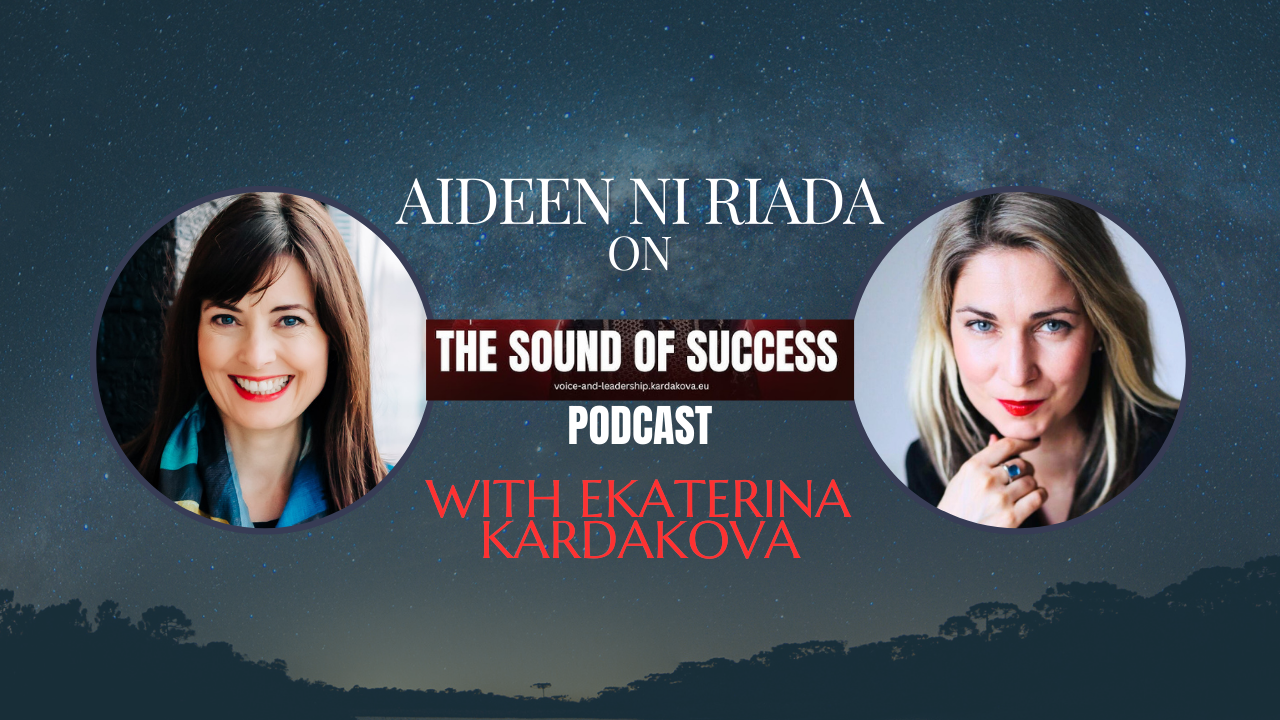
My voice journey began with a block - a quiet, persistent belief that using my own voice wasn’t safe.
Maybe you’ve felt that too.
Maybe your “voice” feels stuck… not just in singing, but in speaking up, being seen, sharing your gifts, or telling the truth about who you really are.
And here’s what I learned on the long walk back to myself:
Finding your voice has very little to do with sound. It has everything to do with knowing yourself, accepting yourself, and loving yourself enough to be fully expressed.
Your voice whether spoken, sung, written or expressed in other ways is an extension of your inner truth.
And truth can feel vulnerable.
As Shared on The Sound of Success Podcast
I talk more about this on my conversation with Ekaterina Kardakova on her podcast The Sound of Success, including why vulnerability and creativity are essential to finding your true voice.
In our conversation, we explore why expressing yourself feels so vulnerable, how your voice reveals truths you may not even realize you’re holding, and why creative play is one of the gentlest paths back to self-trust. If you'd love to hear the full story and a few surprising insights about confidence, culture, and the soul of the voice… you can watch the full episode below.
You can watch the full episode below! And please get in touch if you’d like some help finding your voice!
Why Using Your Voice Feels So Scary
The voice is instantaneous.
It reveals how we feel before we can hide or polish it.
Words spill out faster than the brain can control.
And because we can’t predict exactly how we will sound unless we’ve practiced, the body interprets expression as risk.
That’s why people say:
“No, no, I can’t speak up.”
“I don’t know what to say.”
“I might mess it up.”
The fear isn’t really about singing.
It’s not even about speaking.
The fear is about being seen. Being known. Being real in the moment.
This is why creative activities that are fun, playful, or a little challenging help us grow.
They gently nudge us into the unknown, building our tolerance for discomfort so we don’t avoid it.
Creativity becomes a training ground for confidence — a place to practice self-trust.
Creativity Is a Doorway Back to Yourself
People often think “finding your voice” means learning how to speak louder or sing better.
But truly finding your voice means:
reconnecting with your inner world
listening to yourself
expressing what is true
honouring what you feel
trusting your unique way of seeing life
Creativity helps you do this because it bypasses the part of you that overthinks. When you’re in a playful, curious state like when singing, painting, dancing, journaling, doodling, cooking, arranging flowers, you naturally relax into yourself.
Creativity isn’t about skill.
It’s about connection — with yourself.
Here are some ways you can rediscover your voice:
humming while making tea
colouring without worrying about the lines
dancing in the kitchen for 30 seconds
journaling one honest sentence
rearranging a room so it feels like you
speaking a thought out loud before editing it
walking while whispering what you’re grateful for
Anything that helps you drop the mask, anything that feels playful or expressive, helps you hear yourself more clearly.
From Ireland to Everywhere: Why Expression Matters
I grew up in Ireland, where people sing together naturally - around tables, in pubs, at celebrations and sorrows alike.
No one is performing.
We’re simply connecting.
Many cultures share this instinct.
But even if you weren’t raised in a musical tradition, you can still build your voice.
Your Voice Is Communication — Not Performance
Your true voice… spoken, sung, written, or expressed creatively is simply the place where your inner world meets the outer world.
It’s how you say:
This is who I am.
This is what matters to me.
This is what I’m learning.
This is what I need.
This is what I love.
Finding your voice is finding the courage to share your inner truth without shrinking or apologizing for it.
And sometimes the simplest playful sounds, like my favourite silly warm-up, the MEOW, help unlock that freedom.
Not because of technique, but because:
When you allow yourself to play, you allow yourself to breathe.
When you breathe, you express.
When you express, you return to yourself.
Why We Hold Back Our Voices
Most people don’t silence themselves because they’re weak.
They silence themselves because:
they were criticized as children
they were taught to be “good”
they learned to stay small
they feared being “too much”
they believed someone else’s opinion
they experienced embarrassment or shame
Our body remembers.
Our jaw tightens.
Our breath shortens.
Our throat closes.
It’s not failure - it’s protection.
But protection is not the same as expression.
Finding your voice means gently teaching your system that it is safe to be seen again.
Please get in touch if you’d like some help finding your voice!